cs101 midterm past papers with answers pdf | cs101 midterm past papers virtual university
Preparing for the CS101 (Introduction to Computing) midterm can feel like trying to learn a new language overnight. Whether you are navigating binary conversions, understanding the history of hardware, or trying to wrap your head around basic algorithms, the pressure is real.
One of the most effective ways to bridge the gap between “reading the slides” and “acing the exam” is by practicing with CS101 midterm past papers with answers. In this comprehensive guide, we will explore why past papers are your best friend, how to use them effectively, and provide the insights you need to secure top marks.
Why Past Papers are Essential for CS101 Success
In the world of computer science, theory only takes you halfway. The CS101 curriculum covers a vast range of topics—from the internal architecture of a CPU to the logic of HTML and networking. Here is why downloading a CS101 midterm past papers PDF is a game-changer:
- Familiarity with Exam Patterns: Every university has a specific style. Some focus heavily on Multiple Choice Questions (MCQs), while others prefer short descriptive answers or logic-based problems.
- Time Management: Practicing with a timer helps you realize how much time you can afford to spend on a single binary conversion before you need to move on.
- Identifying High-Yield Topics: You will quickly notice that certain concepts—like the Von Neumann architecture or the difference between RAM and ROM—appear almost every year.
- Reducing Exam Anxiety: There is a psychological “win” in seeing a problem you’ve already solved during your practice sessions.
Core Topics Covered in CS101 Midterm Exams
Before diving into the papers, you need to know what you’re looking for. Most CS101 midterm exams cover the first 15 to 22 modules of the course. Here is a breakdown of the “heavy hitters”:
1. Hardware and History
Expect questions on the generations of computers (from vacuum tubes to microprocessors). You should also be comfortable explaining the System Unit, motherboard components, and the role of the BIOS.
2. Binary and Data Representation
This is often the most technical part of the midterm. You must master:
- Converting Decimal to Binary and vice-versa.
- Understanding Bits, Bytes, Kilobytes, and Terabytes.
- The basics of ASCII and Unicode.
3. Software Categories
Be ready to differentiate between System Software (Operating Systems, Drivers) and Application Software (Word processors, Browsers).
4. Networking and the Internet
Common questions include the definition of IP addresses, the difference between LAN and WAN, and how Search Engines index the web.
How to Effectively Use CS101 Past Papers with Answers
Simply downloading a PDF isn’t enough; you need a strategy. Follow these steps to maximize your retention:
Step 1: The “Blind” Attempt
Before looking at the provided answers, try to solve at least one full paper using only your current knowledge. This highlights your “blind spots” immediately.
Step 2: Analyze the Answer Key
Once finished, compare your answers with the CS101 solved past papers. Pay close attention to the terminology used in the answers. Computer science examiners look for specific keywords like “volatile memory,” “protocol,” or “compiler.”
Step 3: Categorize Your Mistakes
Did you lose marks because you didn’t know the fact, or because you misunderstood the question? If it’s a conceptual gap, go back to your handouts or video lectures for that specific module.
Sample MCQs from CS101 Midterm Past Papers
To give you a head start, here are some frequently asked questions found in CS101 midterm archives:
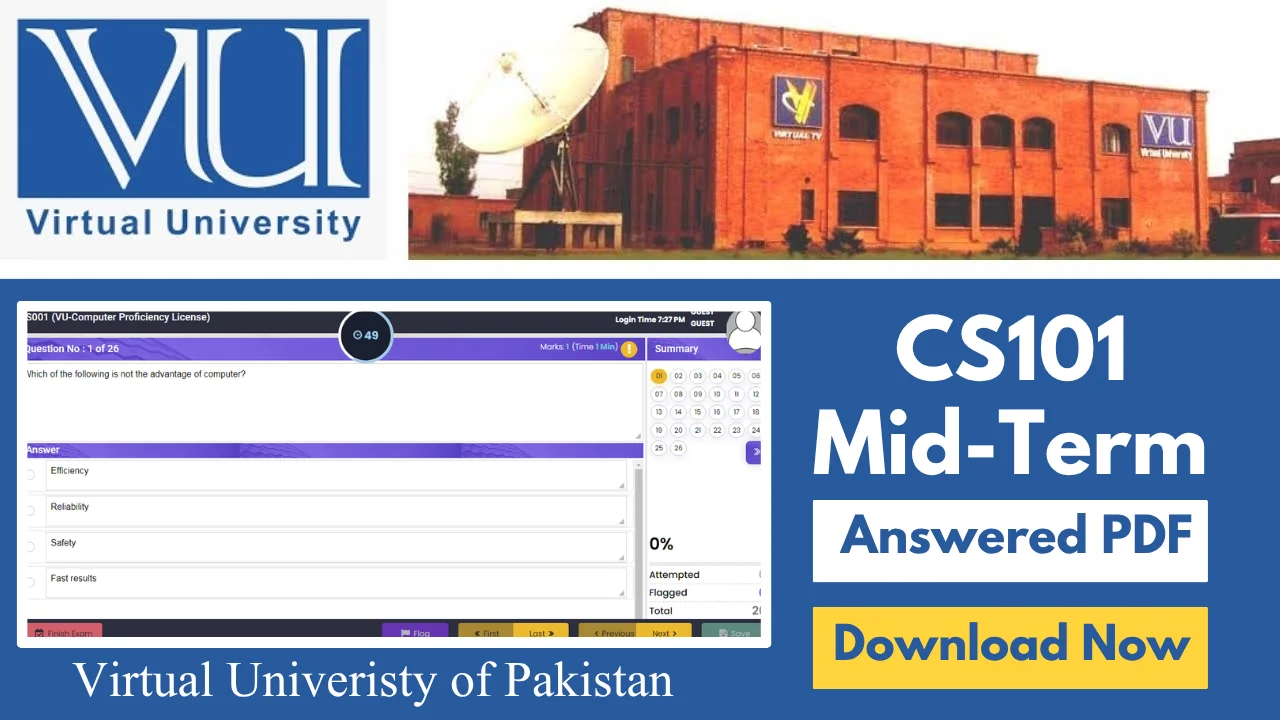
- Which of the following is known as the “brain” of the computer?
- (A) RAM
- (B) CPU (Correct)
- (C) Hard Disk
- (D) Monitor
- 1 Byte is equal to how many bits?
- (A) 4 bits
- (B) 8 bits (Correct)
- (C) 16 bits
- (D) 32 bits
- Which software acts as an interface between the user and the computer hardware?
- (A) MS Word
- (B) Operating System (Correct)
- (C) Antivirus
- (D) Device Driver
Study Tips for the CS101 Midterm
Beyond practicing papers, here are some “pro-tips” from students who have consistently scored 4.0 GPAs in introductory computing:
- Don’t Ignore the “Old” History: It’s easy to skip the history of Charles Babbage or the ENIAC, but these are “easy points” in the MCQ section.
- Visualize the Process: When learning about how the Internet works (TCP/IP), try to draw a diagram of how a packet travels from one computer to another.
- Use Active Recall: After reading a module, close your book and try to explain the concept out loud as if you were teaching a friend.
- Focus on Logic: CS101 isn’t about memorization; it’s about understanding how data flows. If you understand why RAM is volatile, you won’t need to memorize the definition.
Where to Find the Best CS101 Midterm Past Papers PDF
Finding high-quality, solved past papers can be a chore. Look for resources that offer:
- Moaaz Siddiq’s Solved Papers: Widely recognized for accuracy in the Virtual University (VU) community.
- Waqar Sidhu’s Files: Excellent for those looking for categorized MCQs.
- University Portals: Always check your student LMS or departmental archives first.
Pro Tip: Ensure the papers you are using are updated to the current semester’s syllabus. Computing changes fast, and while binary stays the same, software trends do not!
Frequently Asked Questions (FAQs)
Are past papers enough to pass the CS101 midterm?
While past papers are excellent for practice, they should supplement your primary handouts. Use them to test your knowledge, not as your only source of study.
How many years of past papers should I solve?
Ideally, you should look at the last 3 to 5 years of midterm papers. This gives you a broad view of how the questions have evolved.
What is the passing criteria for CS101?
This varies by institution, but generally, you need to score at least 20-50% in the midterm to stay on track for a good final grade. Check your specific course outline for “weighted” grading.
Where can I get the CS101 midterm past papers with answers PDF?
Many student forums and educational blogs host these files. Look for “Mega Files” which often combine multiple years into a single download.
Final Thoughts
Success in CS101 is about consistency. By integrating CS101 midterm past papers with answers into your study routine, you transform from a passive reader into an active problem solver. Remember, every expert programmer started exactly where you are—learning what a “bit” is and wondering why computers use binary.
Stay focused, practice hard, and use the resources available to you. Good luck with your midterms!